Prepare for upcoming exams (PSAT, SAT, ACT, SHSAT, Regents) or get extra help in your middle school or high school subjects. Experience as a teacher, a K-12 textbook editor, an AP grader, and a tutor helps me help you.
PSAT Math
The question is asking for the minimum value of the function, in other words, the y-value in a certain domain. Since we are looking for the minimum y-value when x is greater than -4 and less than 6, we can rule out choice A. We can also rule out choice B because that is an x-value and not a y-value. The lowest y-value given the domain limitations is going to be where x is -4. At that point, y is -2. That's our answer: -2.
ACT Question of the Day - Science
Let's look a little more closely at the ACT question of the day (a great place to visit daily if you aren't yet doing it):
Passage II
The Sun's path from sunrise to sunset varies with the time of year. A student performed the following experiments on three clear, sunny days at three- or four-month intervals throughout the course of a year to study the path of the Sun through the sky.
Experiment 1
At a chosen Northern Hemisphere location, the student placed a stick vertically into the ground so that 1 meter of its length was left above ground. The student knew that the length of the shadow was related to the height of the Sun above the horizon and that the shadow would point away from the direction of the Sun. The length in meters (m) and direction of the shadow cast by the stick were measured one hour after sunrise (Shadow A), at mid-morning (B), at noon (C), at mid-afternoon (D), and one hour before sunset (E) on each of the three days. The direction of each shadow was determined by placing a magnetic compass at the base of the stick and aligning the north arrow with the north mark on the compass. The direction of each shadow was then determined by a comparison with the compass face markings. The results are recorded in Table 1.
| Table 1 | ||||||
| Shadow | Day 1 | Day 2 | Day 3 | |||
| Length (m) | Shadow direction | Length (m) | Shadow direction | Length (m) | Shadow direction | |
| A | 5.0 | SW | 8.6 | NW | 6.8 | W |
| B | 1.2 | W | 2.9 | NNW | 1.7 | NW |
| C | 0.3 | N | 2.3 | N | 0.9 | N |
| D | 1.2 | E | 3.0 | NNE | 1.8 | NE |
| E | 5.0 | SE | 8.6 | NE | 6.9 | E |
| Experiment 2 The following year, the student repeated Experiment 1 at a chosen location in the Southern Hemisphere. The results are in Table 2. |
| Table 2 | ||||||
| Shadow | Day 1 | Day 2 | Day 3 | |||
| Length (m) | Shadow direction | Length (m) | Shadow direction | Length (m) | Shadow direction | |
| A | 9.0 | SW | 5.0 | NW | 6.9 | W |
| B | 3.2 | SSW | 1.1 | W | 1.8 | SW |
| C | 2.5 | S | 0.3 | S | 1.0 | S |
| D | 3.2 | SSE | 1.1 | E | 1.8 | SE |
| E | 9.1 | SE | 5.0 | NE | 6.9 | E |
Which of the following was a constant in both experiments?
The ACT is a test not only of knowledge and aptitude, but one of time management. This question shows that looking at the actual question first can save you a lot of time. When I started this problem, I read through the paragraphs and all the experiment text, and then I looked through the data in the table... only to find that I could have saved a lot of time by figuring out what information I needed. Now, this isn't the best strategy for every ACT section, but in the science section, it can definitely help to skim over the questions before reading a passage.
The correct answer is F. Length of vertical stick exposed. It was stated in Experiment 1 that the length of the stick exposed above ground was one meter, and the procedure was repeated in Experiment 2. So the length isn't changing. It is constant. The shadow direction and length change constantly, so neither of those choices could work. As for choice H, six different days were used, and it is not clear from the information given if those same six days were used for Experiment 2.
Keep in mind, the ACT science section does not have so much to do with knowledge as with processing information you are given. There is a lot of chart and graph reading.
PSAT Practice Problem - Algebra
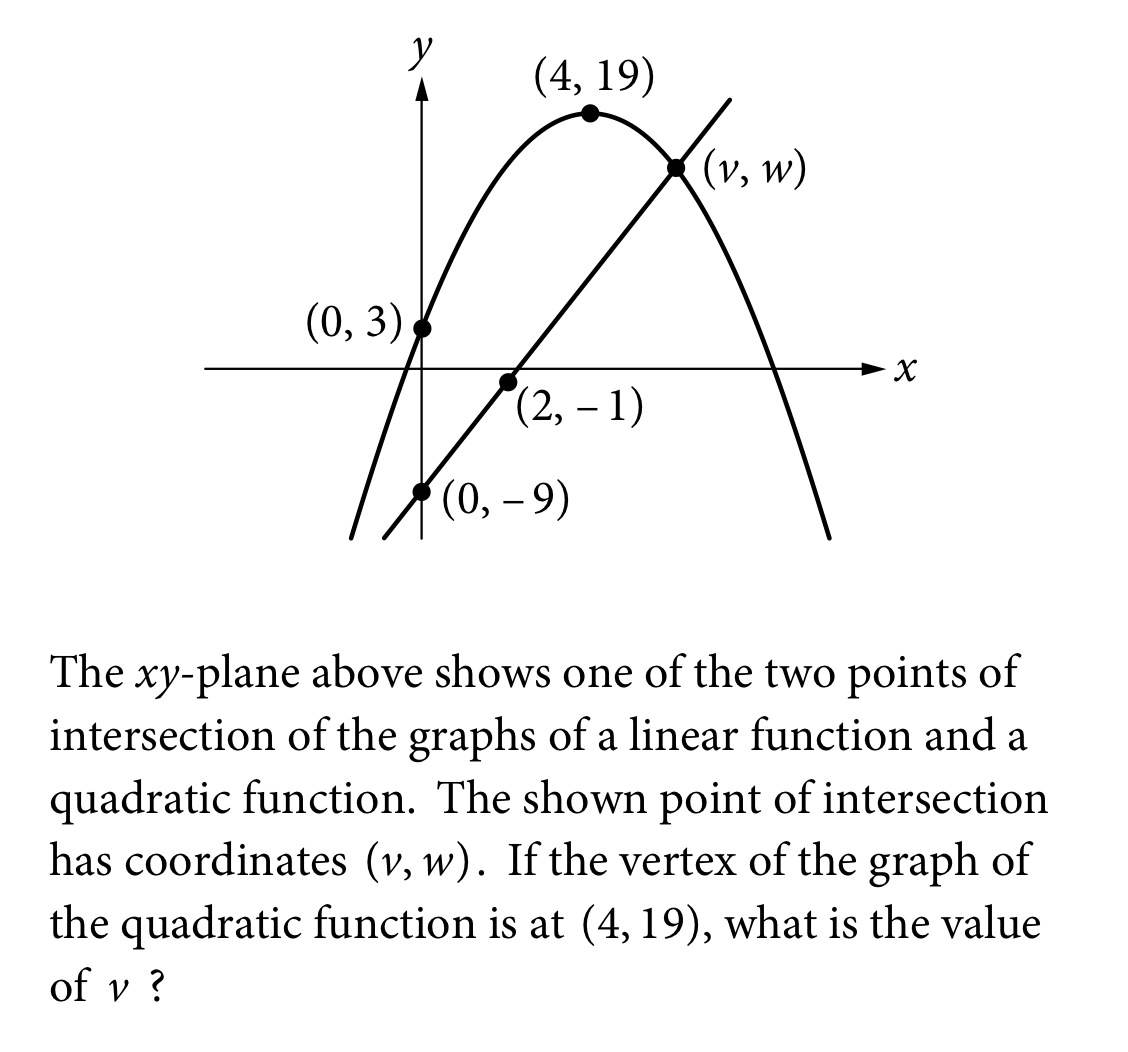
Let's work through a PSAT problem. (Click on any of the images to make them bigger).
First, let's find the equation of the parabola by putting the coordinate for the vertex into a vertex-form quadratic equation, y = a(x-h)2 + k, where the vertex is (h, k).
We need to find a, so let's use the other point given on the parabola (0,3) and plug it in the equation.
Let's put that back in the quadratic equation.
Now we need to find the equation of the linear function. First we'll find the slope of the line, and then we'll use the y-intercept of the line to complete the equation.
Now we need to solve the system of equations. We can find the solutions (the two places they touch) by setting both equations equal to each other.
Let's solve.
Since we want the point that's on the right side of the y-intercept, we know that x is going to be positive, so the answer we want is 6. v, which is representing the x-coordinate of the solution of the system of equations, is 6.
Subscribe to:
Posts (Atom)